
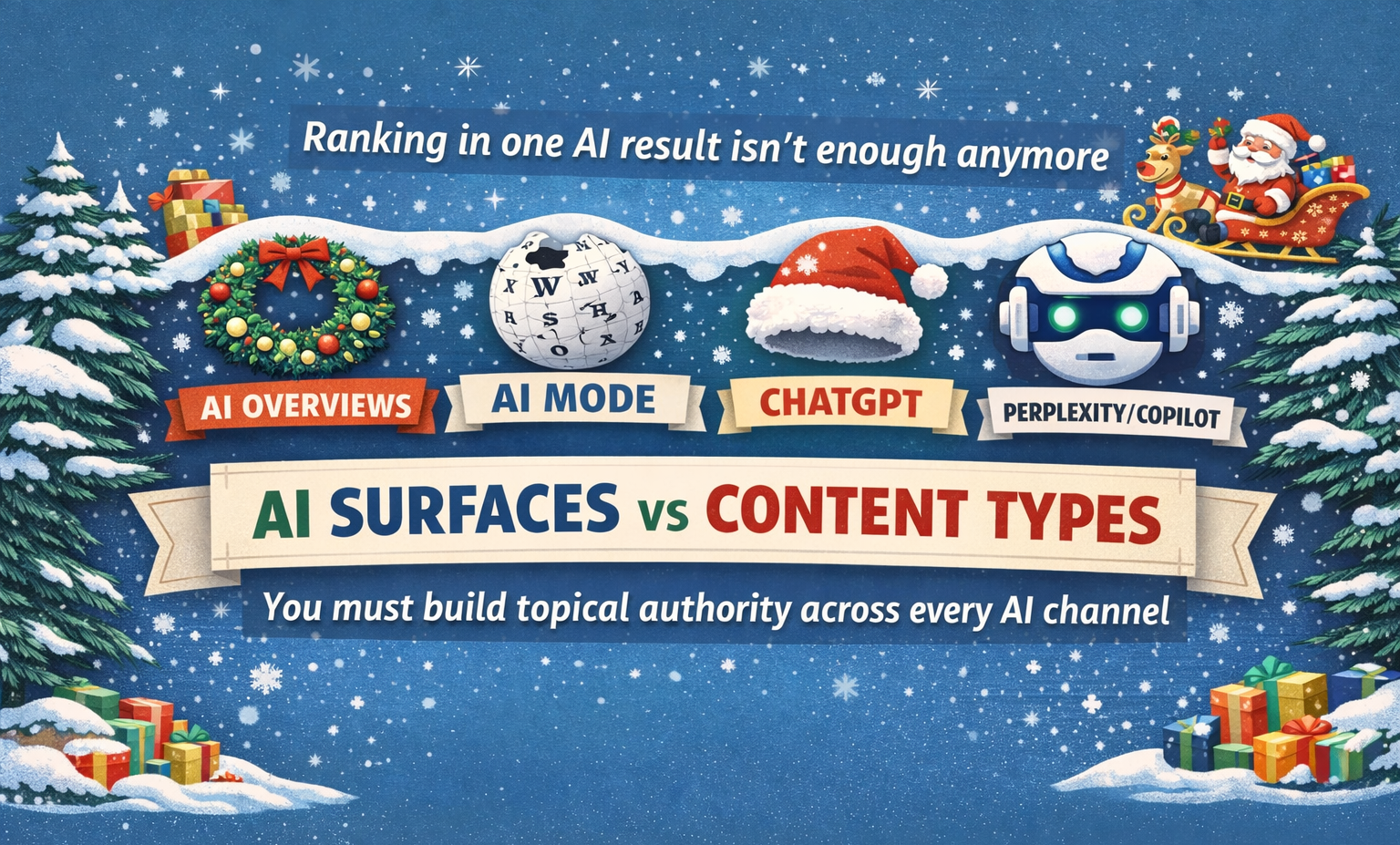
AI Surfaces vs Content Types: Why Ranking in One AI Result Isn’t Enough Anymore
If your business is showing up in AI-powered search results, that’s great—but here’s the uncomfortable truth:
Visibility in one AI surface does not guarantee visibility in another.
Recent large-scale research from Ahrefs confirms what we’ve been seeing firsthand at Yroc Consulting:
AI search is no longer a single channel. It’s a multi-surface ecosystem, and each surface pulls trust from different types of content.
In this article, we’ll break down:
-
What “AI surfaces” actually are
-
Why AI Overviews and AI Mode behave differently
-
How content types map to each AI surface
-
And what businesses must do to build real, defensible AI authority
What Are “AI Surfaces”?
An AI surface is any interface where artificial intelligence generates answers and recommendations using external sources.
Examples include:
-
Google AI Overviews
-
Google AI Mode
-
ChatGPT
-
Perplexity, Bing Copilot, and similar AI assistants
While these tools often answer the same questions, they do not rely on the same sources—or reward the same content.
That distinction matters.
AI Overviews vs AI Mode: Same Question, Different Rules
Ahrefs analyzed 730,000+ AI responses and uncovered something critical:
-
AI Overviews and AI Mode share only ~13.7% of citations
-
In other words, 87% of their sources are different
-
Yet their answers are 90% semantically similar
Think of it like two experts giving the same advice—one cites research papers, the other cites real-world case studies. Same conclusion. Different trust signals.
What this tells us:
-
AI does not think in keywords
-
AI thinks in concepts, entities, and topical relationships
Why This Breaks Traditional SEO Thinking
For years, SEO taught businesses to:
-
Optimize a page
-
Rank a keyword
-
Win traffic
AI search changes the goalpost.
Now the goal is:
Be recognized as a trusted entity across multiple AI surfaces
That requires content diversity, not just optimization.
The AI Surfaces vs Content Types Framework
Here’s the framework we use to explain what each AI surface prefers—and why a single content strategy no longer works.
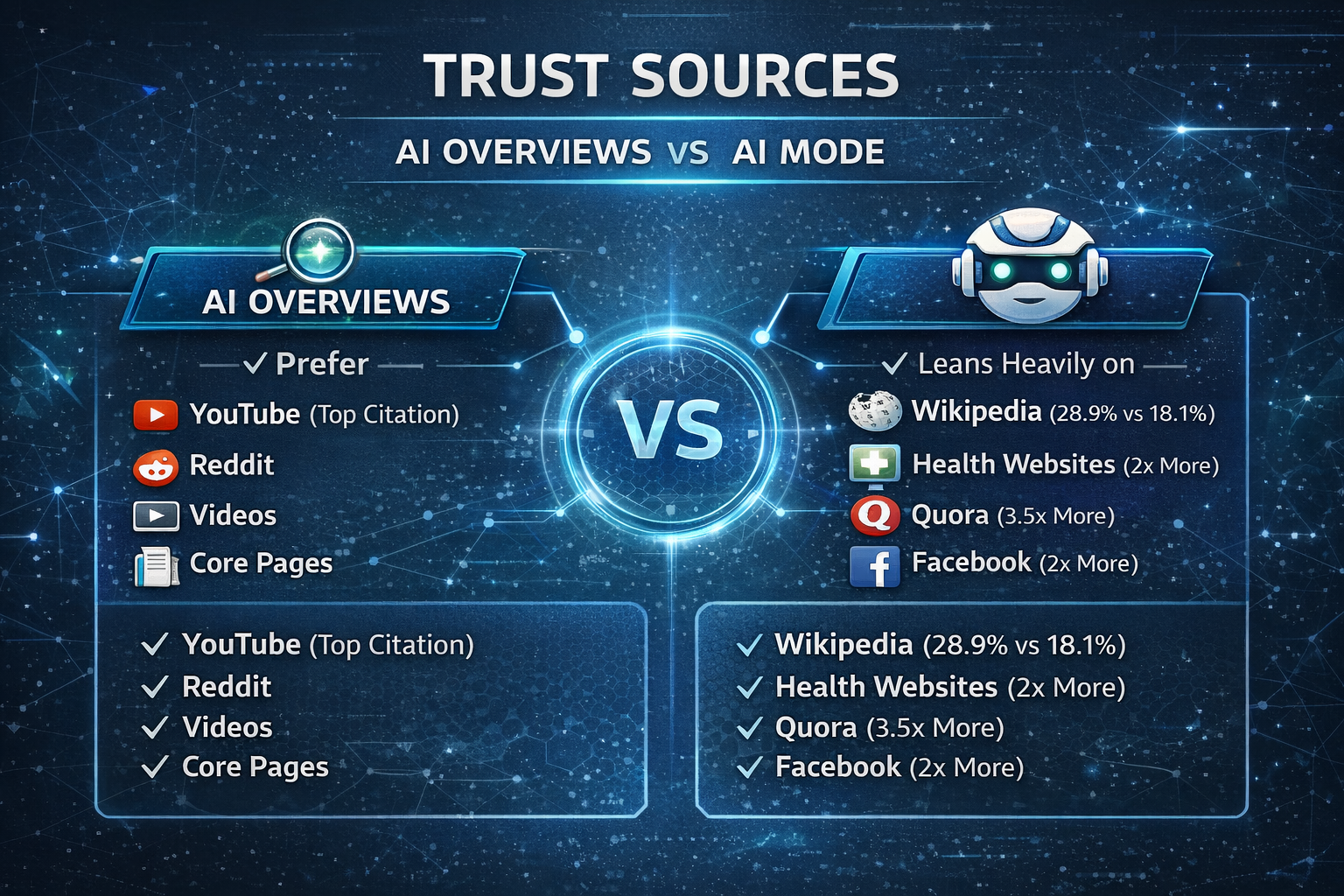
🟥 AI Overviews
What it trusts:
-
YouTube
-
Reddit
-
Video content
-
Strong core website pages
Best content types:
-
Explainer videos
-
Community-driven discussions
-
Clear, concise service pages
-
“Best of” and summary-style content
Why:
AI Overviews are designed to give fast, confident answers. They prioritize clarity, popularity, and engagement signals.
🟦 AI Mode
What it trusts:
-
Wikipedia
-
Quora
-
Health and authority sites
-
Encyclopedic resources
Best content types:
-
In-depth guides
-
Well-cited educational content
-
Definitions, processes, and frameworks
-
Entity-rich pages
Why:
AI Mode behaves more like a research assistant. It rewards completeness and credibility over brevity.
🟩 ChatGPT
What it trusts:
-
Broad web crawl data
-
Q&A patterns
-
Conceptual consistency
Best content types:
-
Thought leadership articles
-
Clear explanations
-
Story-driven insights
-
Structured FAQs
Why:
ChatGPT synthesizes patterns across the web. It surfaces brands that explain topics well – not just those that rank.
🟪 Perplexity & Copilot
What they trust:
-
Research papers
-
Academic sources
-
Recent news
-
High-authority citations
Best content types:
-
Whitepapers
-
Case studies
-
Data-backed content
-
Press and expert commentary
Why:
These tools emphasize verifiability. They want sources that look authoritative even under scrutiny.
The Big Shift: From Keywords to Topical Authority
One of the most important insights from the Ahrefs study is this:
Exact phrase overlap matters less than semantic relevance.
That means:
-
You don’t need to match the question word-for-word
-
You do need to fully cover the topic
This is why topical authority beats page-level optimization in AI search.
What Businesses Should Do Now
Here’s the practical takeaway:
-
Track AI Overviews and AI Mode separately
They are different channels with different rules. -
Stop assuming one AI win equals total AI visibility
It doesn’t. -
Build content ecosystems, not isolated pages
Blogs, videos, FAQs, guides, citations—all matter. -
Optimize for entities and topics, not just keywords
AI rewards brands that “own” a subject.
How Yroc Consulting Helps Businesses Win in AI Search
At Yroc Consulting, we don’t optimize for one AI result.
We help businesses:
-
Build entity authority
-
Align content with multiple AI surfaces
-
Create AI-friendly structure, schema, and topical depth
-
Show up where customers are actually searching—now and next
Because in the AI era, visibility isn’t about ranking once.
It’s about being recognized everywhere that matters.
Final Thought
AI success is multi-channel. One citation is not authority.
If your brand isn’t intentionally building across AI surfaces, you’re leaving visibility—and trust—on the table.
If you want help auditing or building your AI presence the right way, that’s exactly what we do.

Yroc Consulting
We live in SEOville, USA, drink only from the fountains that produce the highest ROI, and dine on warm leads. Our goal is to help Optimizers, Agency Owners, Freelancers, Single Moms, Corporation Owners, and you through the complex world of internet marketing.
Recommended Posts

How AI Is Changing Marketing
April 28, 2026
How to Earn Brand Mentions in AI Search
February 12, 2026