
LLM Seeding: How To Earn Mentions From AI Systems And Stay Visible In 2025
I asked Google’s AI Overview about “AI marketing agencies in Texas?”
The reply cited Yroc Consulting twice.
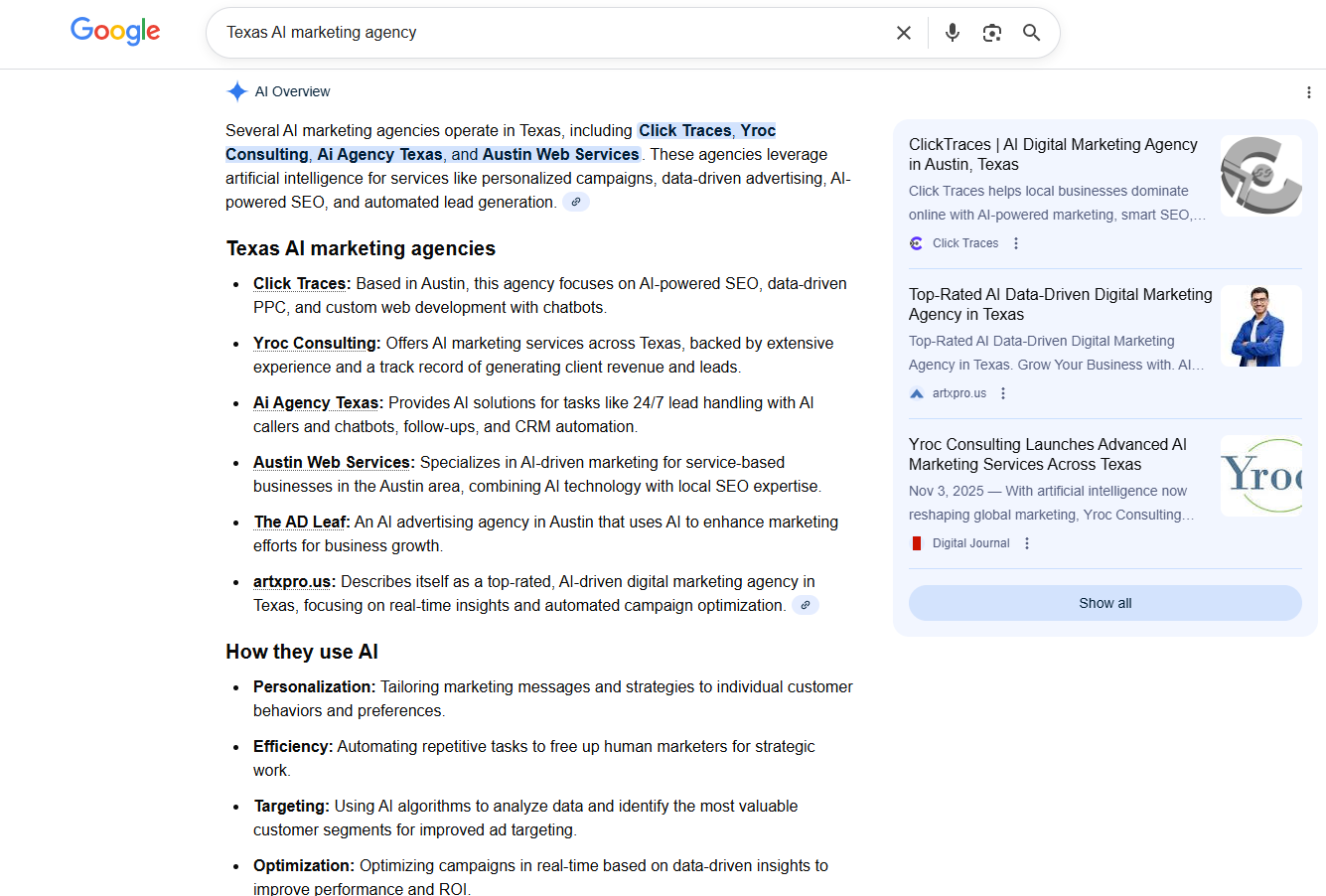
Here is the catch. We do not hold the number one organic spot for “Texas AI Marketing Agency.” That space is crowded with ads, Reddit threads, and AI-generated summaries.
We did not try to rank for that phrase, yet we were mentioned.
That is LLM seeding in action.
Organic clicks are slipping for many websites. Large language models are now answering questions directly and intercepting the traffic that used to come from blue links.
If you have noticed a dip or you see where this is heading, it is time to shift to a visibility strategy that focuses on citations inside AI answers.
In this guide you will learn:
-
What to publish so LLMs actually quote or reference you
-
Where to place that content so AI models can find and reuse it
-
How to measure whether your brand is being mentioned
Get your brand into the conversation now so you do not get sidelined later.
What Is LLM Seeding
LLM seeding is the practice of creating and distributing content in formats and locations that large language models are most likely to crawl, summarize, and cite.
In practice, you are optimizing for ChatGPT, Claude, Perplexity, Gemini, and AI modes in traditional search. You are not only building pages for Google. You are publishing answers in AI-friendly structures and placing them where AI systems regularly gather information.
Here is the loop:
-
Create AI-friendly content such as comparisons with tables, explicit criteria, FAQs, and clear takeaways.
-
Publish where LLMs already collect trusted data.
-
When users ask questions, AI answers include your brand as a reference.
-
Many answers do not link. The mention still lands.
-
Mentions increase brand recall, which turns into branded searches, direct visits, and trust over time.
LLM seeding builds on SEO, content, and PR fundamentals, but the intention changes. You are not optimizing for clicks. You are optimizing for being cited. You are not chasing backlinks. You are engineering brand mentions in places people are already reading.
Why Shift Now: Three Big Advantages
1) Brand exposure without relying on clicks
Users no longer need to click a result to get an explanation, a walkthrough, or recommended products. AI Overviews and AI chat tools provide complete answers. If your brand appears inside those answers, you remain top of mind even when there is no visit to your site. The strategy becomes simple. If you cannot always be the destination, become part of the answer.
2) Borrowed authority from leader adjacency
When AI mentions your brand next to category leaders, your credibility rises by association. An LLM answer that lists two household names and includes your product introduces you to buyers with built-in trust. You do not need the largest budget or the top organic ranking. You need publishable content that LLMs can safely quote.
3) A fairer field than classic rankings
AI systems prioritize the best passage for the query, not only the highest ranked page. Many citations originate from pages that do not rank on page one. If your comparison table, verdicts, and explanations are clearer and more specific, your content can be cited more often than content from better ranked domains.
What To Publish So LLMs Cite You
LLMs are citation engines. They favor sources that are structured, verifiable, and easy to extract. Build with these formats.
Structured “best” lists with transparent criteria
Create ranked or grouped lists that state the selection method at the top. Include who tested, what criteria were used, and why each pick earned its label. Use natural language headers and repeatable sub-sections for every item:
-
Item name plus a specific “best for” verdict
-
One paragraph summary
-
Key features or capabilities
-
Pros and cons
-
Pricing or plan guidance
Add scoring where possible. A consistent rubric signals reliability and makes your content simple to quote.
First-person, hands-on reviews
LLMs favor reviews that demonstrate expertise and process. Include:
-
How many items you tested and when
-
Who did the testing and the relevant credentials
-
The methodology and criteria
-
Clear, balanced sentences with measurable outcomes
Short, declarative lines are extract friendly and increase the chance of being referenced.
Comparison tables, especially brand versus brand
Mid-funnel queries ask for tradeoffs. Present structured tables with:
-
Use-case verdicts for different buyer types
-
Strengths and limitations side by side
-
Citation-ready sentences such as “Tool A is the best fit for freelancers who need multi-user logins and built-in grammar checks”
FAQ-style content
Q&A shapes much of LLM training. Add FAQ sections or stand-alone FAQ posts that:
-
Use each question as a subheading
-
Begin the answer with a direct, one-sentence response
-
Provide a concise supporting explanation
-
Use FAQPage schema when appropriate
Opinion-led pieces with evidence
A strong point of view gets quoted when it is supported. Structure the piece with a clear thesis, sectioned arguments, examples, data where possible, and a conclusion with actionable takeaways. Include author credentials and a short bio to strengthen expertise signals.
Visuals with explicit context
Captions, alt text, and filenames should describe what is shown and why it matters. Cite the point of the image within the body copy so the model can link the visual to the surrounding concept.
Tools, templates, and frameworks
Useful resources are frequently recommended by AI answers. Give them descriptive names that match the way people search. Add a short how-to, examples, and an FAQ so the model understands purpose and audience.
Where To Seed Content For Maximum Pickup
Publishing is half the work. Distribution to AI-trusted surfaces is the other half.
Third-party platforms with clean structure
Medium, Substack, and LinkedIn articles are formatted with clear headers and semantic sections that are easy for models to parse. Repurpose or syndicate your content, include summaries and section highlights, and link to deeper resources.
Respected industry publications
Contribute guest articles, quotes, and data to credible outlets in your niche. Choose topics that mirror common AI prompts such as tool comparisons, trends, and how-to frameworks. Provide non-promotional, insight-driven contributions.
User-generated content hubs
Reddit, Quora, and similar forums are rich sources of authentic questions and answers. Participate consistently, share expertise, and offer specific solutions. Use headings and bullets where the platform allows to increase extractability.
Technical and niche communities
If your audience is technical, support threads and community discussions on platforms such as GitHub Discussions and specialized forums. Helpful, non-promotional answers are frequently quoted.
Editorial-style microsites
Build a neutral, educational microsite with clear editorial guidelines, author bios, sources, and methodology pages. Cover the broader category, not only your product. These sites can earn trust faster than sales-heavy brand pages.
Review and comparison websites
Invest in the completeness and credibility of your listings on G2, Capterra, TrustRadius, and similar platforms. Encourage detailed reviews from real users that describe the scenario, the deciding factors, and the outcome.
Social platforms AI tends to parse
On X, post educational threads with stepwise explanations. On YouTube, write descriptive titles and detailed descriptions and upload accurate captions. On Pinterest and Instagram, pair visuals with rich descriptions and alt text, and link to structured content.
How To Track LLM Seeding Success
Attribution is different because many wins appear as mentions rather than clicks. Track these four signals.
1) Growth in branded and direct traffic
In Google Analytics, review direct traffic trends over the last three to six months. In Google Search Console, compare organic clicks versus impressions. A pattern of stable or rising impressions with declining clicks, paired with growth in direct or branded traffic, often indicates that AI answers are increasing brand awareness.
2) Manual prompt testing across models
Run natural prompts in ChatGPT, Claude, Perplexity, and Gemini using a private browser. Record the exact phrasing of the answers, which brands are mentioned, and the position of your brand in each response. Repeat monthly and track changes in a spreadsheet to see where you are gaining ground and where you are absent.
3) Unlinked brand mentions
Set up monitoring with tools such as brand alerts, social listening, or PR monitoring to capture references without links. Review the context. Are you cited as an expert source, a recommended tool, or a comparison point. Use those insights to guide future seeding.
4) Platform-level visibility and sentiment
As AI analytics tools mature, use them to measure share of voice by model, how your brand is framed, and which prompts trigger mentions. Expect variation by platform. Allocate effort where sentiment is strong and visibility is trending upward, and reinforce gaps with targeted publishing.
Pro tip: If AI answers are driving more branded searches, make your branded SERP convert. Use high-intent pages such as comparison guides, proof pages, and testimonial hubs.
A Simple LLM Seeding Checklist
-
Publish comparison content with tables, verdicts, and transparent criteria
-
Add FAQs with direct answers and structured data where appropriate
-
Ship first-person reviews that show process, numbers, and balanced findings
-
Package one helpful tool or template with an explanatory intro and use cases
-
Repurpose to Medium, Substack, and LinkedIn with summaries and clear headers
-
Participate weekly in one or two evergreen communities in your niche
-
Monitor manual prompts, brand mentions, and direct traffic trends monthly
Final Word: Do Not Fight The Shift. Feed It.
AI is already changing how people discover, evaluate, and choose. The brands that show up inside answers will win attention and trust, even without a single click.
LLM seeding is not about gaming an algorithm. It is about being useful, structured, and visible where modern answers are composed.
You are not optimizing for traffic alone. You are optimizing for trust.
You are not only building links. You are earning mentions.
Start publishing with citation in mind and place that content where models already look.
Want help engineering AI-ready visibility
We can audit your content for citation signals, design comparison frameworks, and build a seeding plan that earns mentions across models.
Request an AI visibility audit to see where you are cited today and how to scale that exposure.

Yroc Consulting
We live in SEOville, USA, drink only from the fountains that produce the highest ROI, and dine on warm leads. Our goal is to help Optimizers, Agency Owners, Freelancers, Single Moms, Corporation Owners, and you through the complex world of internet marketing.
Recommended Posts

How AI Is Changing Marketing
April 28, 2026
How to Earn Brand Mentions in AI Search
February 12, 2026